


My name is Olly Rutt, and I am the Head of Risk Consultancy at The Keyholding Company. I spent over a decade as an armed police officer and tactical adviser, planning security for major public events.
When I joined The Keyholding Company to lead the TKC Consult division, the context changed but that core discipline did not. That same principle shapes how I view the Terrorism (Protection of Premises) Act 2025, known as Martyn’s Law.
We have the Martyn’s Law guidance, what comes next?
I have followed its development closely, and the publication of the final statutory guidance by the UK Home Office on 15 April 2026 is a significant milestone. While this document provides the foundation needed to move past speculation, interpreting what this means for your estate can still feel overwhelming. With the implementation deadline set for 2027, organisations have the necessary window to establish their readiness in a measured, deliberate way. Getting a head start now could make all the difference.
Unfortunately, we have seen a significant amount of scaremongering within the industry, leading many businesses to view these new duties with a sense of dread.
In my experience, the most effective security comes from strategically placing resources to maximise safety without creating an atmosphere of fear for the public or the teams implementing it.
So, my central message is this: do not panic.
Martyn’s Law is a commitment to practical, proportionate preparedness, not a costly mandate to overhaul existing arrangements.
To help cut through the confusion, I have identified several common misconceptions that are currently circulating. By debunking these myths, we can focus on what really matters: protecting people through practical measures, not complex operational overhauls.
The myths, addressed
Myth 1: You must purchase external products or services to comply
The Home Office guidance is explicit on this point: it is not mandatory to use third-party products or services to meet your obligations.
The intention of the legislation is that companies can achieve compliance through practical measures, sensible procedures and the wealth of free guidance already available.
While some organisations might choose to seek external support to help interpret what is reasonably practicable across a complex estate, that remains a choice rather than a requirement.
Myth 2: Compliance will be an expensive burden
There is a concern that the Act will place an unmanageable financial strain on businesses.
However, cost is built into the concept of reasonable practicability. The measures you take are expected to be proportionate to the specific risk, the nature of the premises and the resources you have available.
Existing procedures, equipment, and staff briefings all count.
In instances where a measure is clearly disproportionate in cost or effort to the additional protection it could provide, finding an alternative and documenting that decision and the reasoning behind it is a perfectly appropriate step.
Martyn’s Law sets a sensible legal baseline, not an expensive gold standard.
Myth 3: Formal qualifications or paid training are required
The final myth I often encounter is the belief that staff will need formal certificates or paid training courses to comply, such as the Level 3 award in Counter Terrorism Protective Security and Preparedness.
This is simply not true. Whilst this is a great qualification and endorsed by Counter Terrorism Policing, the Statutory Guidance only states that staff need training, learning and instruction that is appropriate to their role and responsibilities, and tailored to the specific environment they work in.
No qualification is required. What matters is that you have suitable procedures in place that your staff understand and can apply should an incident occur.
While the depth of these processes will always depend on the specific location, many organisations can successfully achieve this through internal briefings, awareness sessions, and free government resources.
Navigating the road to readiness
If you are responsible for a large or fragmented property portfolio, navigating these requirements across every site can quickly become a complex exercise.
To address this, we have introduced the Protection Readiness Tracker (PRT), an addition to our Risk Management Tool (RMT). It is designed specifically to help security and facilities teams track their actions in one centralised platform.
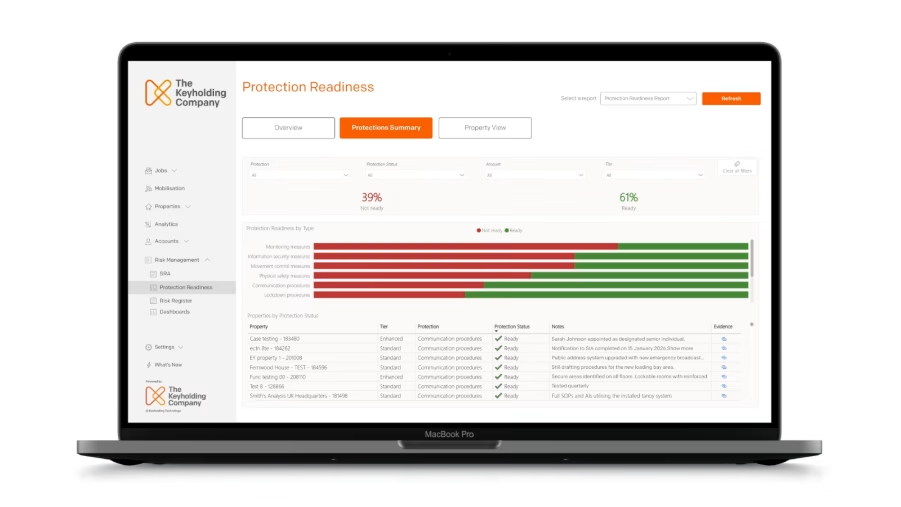
To give the responsible person complete confidence that they are meeting their obligations under Martyn’s Law, site-level assessments and supporting documentation are linked in a single place. This data feeds into estate-level dashboards, allowing teams to identify trends or gaps across an entire portfolio and track readiness by protection type.
Having followed this legislation since its inception, we built this feature because we know that the gap between understanding guidance and implementing it consistently across an estate is where organisations most often struggle. The PRT is designed to close that gap.
Get in touch
If you are working through what the statutory guidance means for your organisation, or if you want to see how the Protection Readiness Tracker can support your planning, don’t hesitate to reach out to me at consult@keyholding.com.
The legislation is manageable. The preparation will be proportionate. And you do not have to navigate it alone.

Want to find out more?
Want to find out more?
Get in touch today to learn more about how the Protection Readiness Tracker can support your organisation’s preparation for Martyn’s Law.
Contact the team